
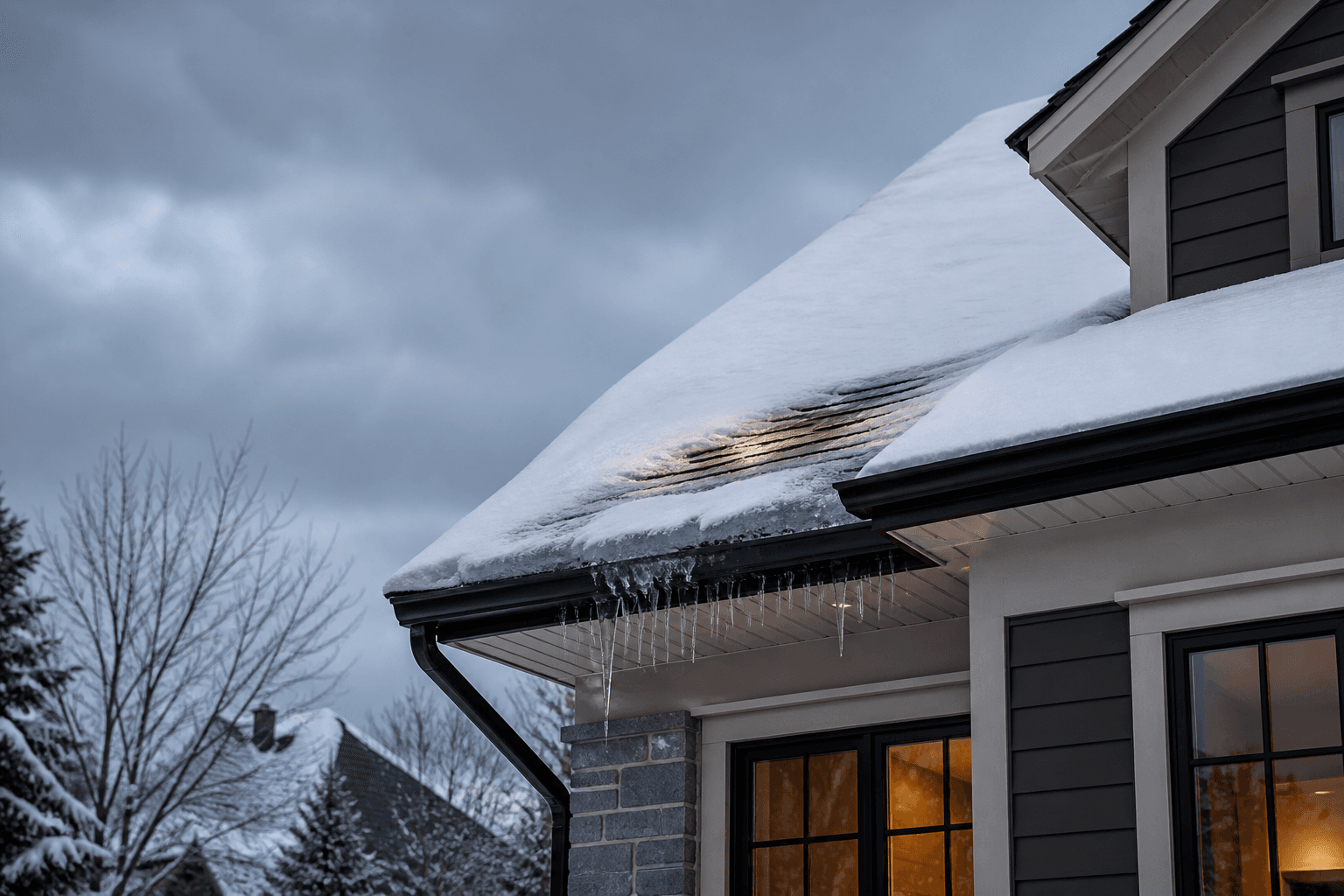
Ice dams form when heat escaping from a home melts snow on the upper roof and the water freezes again near the colder eaves. In Greater Montreal, repeated snow, sun, freezing rain and thaw cycles can turn that narrow ridge of ice into backed-up water beneath roofing materials.
The lasting solution is usually not to attack the ice from outside. Homeowners in Montreal, Laval, Mirabel, the West Island and the South Shore should first control heat and air leakage into the attic, confirm insulation coverage, and review ventilation and roof details as one assembly.
Why do ice dams form on Montreal homes?
Snow can insulate the roof surface. When the attic warms the roof deck above freezing, the bottom layer melts. Water travels toward the eaves, reaches a colder section and freezes. Repeated cycles build a dam that can hold water above shingles, flashing and roof edges.
Complex roof shapes, dormers, valleys, cathedral ceilings and low attic edges are more difficult because heat pathways and insulation depth vary. An icicle alone does not locate the defect, but uneven snow melt after a light snowfall can reveal warm areas worth investigating.
What should you inspect before adding insulation?
Start with moisture and air leakage. Look for frost, stained insulation, wet roof sheathing, disconnected bathroom exhausts and gaps around the attic hatch, wiring, plumbing stacks and chimney chases. Correct roof leaks and exhaust problems before covering them with new material.
Insulation must remain dry, evenly distributed and continuous at the perimeter. Do not disturb vermiculite until it has been appropriately assessed. Recessed fixtures, chimneys and other heat-producing elements also require correct clearances and methods.
Will more attic ventilation stop ice dams?
Not by itself. Ventilation helps keep a properly air-sealed attic cooler and manages limited moisture that enters, but it does not solve uncontrolled warm-air leakage from the home. Adding powered attic fans can even draw more indoor air upward when intake is insufficient.
Soffit pathways should remain open where the roof design uses them, and insulation should not block baffles. The correct vent arrangement depends on whether the home has a conventional attic, a half-storey, a low slope or cathedral ceilings.
What can homeowners do safely during winter?
Observe from the ground and note where snow melts first. Keep exhaust outlets clear and consider professional snow removal when accumulation creates a concern. Government of Canada guidance recommends working in pairs or hiring a professional and warns that roof work must be approached cautiously.
Do not strike the dam with an axe or ice pick; this can damage roofing. Heating cables may create temporary drainage channels but consume energy and do not correct the heat-loss source. Interior stains require prompt investigation because water may travel before becoming visible.
- Photograph melt patterns after light snow.
- Check the attic after a cold snap for frost or wet areas.
- Keep bathroom and kitchen exhausts connected outdoors.
- Arrange safe snow removal instead of climbing onto the roof.
- Plan permanent repairs when conditions allow proper access.
What is the long-term repair plan?
A durable plan usually starts with sealing ceiling penetrations, then improving insulation coverage and confirming ventilation paths. During re-roofing, inaccessible edges, roof membranes, sheathing condition and ventilation channels can be addressed more thoroughly.
Daricson can coordinate roofing, insulation and interior repairs so the cause is addressed before damaged drywall or paint is restored. The approach should reflect the actual roof form and attic conditions, not a universal package.
Frequently asked questions
Are icicles always evidence of an ice dam?
No. Icicles show that water has reached a freezing edge, but an assessment is needed to determine whether water is backing beneath roofing.
Should I remove gutters to prevent ice dams?
Usually not. Gutters direct water away from foundations. Removing them does not correct attic heat loss and can create drainage problems.
Can insulation be added over existing insulation?
Often, if existing material is dry and suitable. Air leaks, moisture sources and hazardous materials must be addressed first.
Why is ice forming only over one room?
That area may contain an attic hatch, exhaust duct, recessed light, missing insulation or another heat pathway. Localized melting is useful diagnostic evidence.
When should I call a contractor?
Call when dams recur, water appears indoors, roof materials are damaged, attic access is unsafe or the cause is unclear.
Plan the next step
Preventing ice dams on Montreal roofs means keeping the roof deck cold and managing water safely. Air sealing, continuous insulation and appropriate ventilation work together; exterior ice removal is only a temporary response.
For recurring ice near the eaves in Greater Montreal, request a Daricson assessment before repairing ceilings or replacing roofing in isolation.